“Finally, President Trump, know respectfully that diplomatic praise is customary, but many Nigerians still judge progress by on the ground reality and that tangible improvements matter. To President Tinubu, understand that international praise is not a verdict, and lasting legitimacy comes first from citizen’s lived experience and measurable results. Diplomatic statements therefore should not substitute for evidence of real progress”
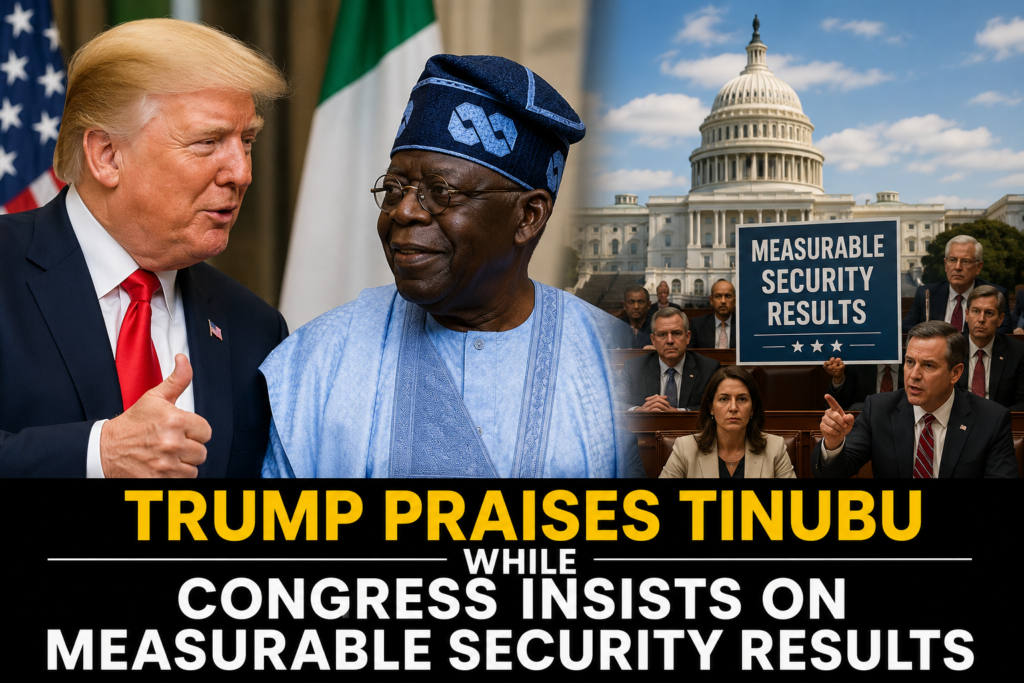
The latest signals from Washington sent a mixed but not necessarily a contradictory message to President Tinubu. On one hand, President Trump has praised President Tinubu’s cooperation on counterterrorism, while on the other hand, congress is pressing for measurable security results before aid moves forward. One acknowledges cooperation, the other insists on measurable outcomes. It is important to note that while the President’s praise can shape the administrations diplomatic posture, he does not control the congress. Lawmakers could take cues from the White House, but they also act on their own assessments and priorities. So, it is possible for Trump’s stance to carry some weight, but not decisive weight. As it would be too soon to describe the situation as a stalemate just yet, for now it is more accurate to say that the White House and Congress are emphasizing different things, cooperation on one side, and measurable outcomes on the other. The key implication is one of interpretation. The praise can read as diplomatic recognition of cooperation and efforts from the government, but with citizens still facing violence, it may feel premature or out of step with daily realities. Ultimately for people on the ground, security is measured less by statements, and more by whether their communities actually become safer. As it is difficult to know President Trump’s motives from only just two events, with one as lavishing encomium on the first lady of Nigeria, Mrs. Oluremi Tinubu at a prayer breakfast in Washington on Thursday, February 5, 2026, and the most recent outpouring of praises on the husband President Tinubu. As a few possibilities though, one is a diplomatic strategy that prioritizes maintaining a cooperative relationship with the government of Nigeria on security matters, another is that diplomatic signaling and domestic public sentiments often operate on different track. To many Nigerians, the timing of the praise may feel hard to reconcile with less insecurity, while diplomacy often serves broader strategic goals. However, the real test is whether any of that translates into tangible safety for ordinary people.
Moreover, what the US House has spoken on publicly centers on religious freedom and civilian protection, rather than the religious composition of Nigeria’s elective ticket. Why that emphasis, one may not be able to assert easily especially without evidence. But we can say categorically that the public focus has been on security outcomes and accountability and not the ticket’s religious balance. Furthermore, an important question raised by recent US statement is not only what Washington emphasizes, but also what it does not. This revelation is a call on all well-meaning citizens of the world to consider the difference between the concern about the structure of the government and concern about the government performance on security. In other words, the focus of President Trump’s public remark has been on what the government does and not how it is composed. His concerns are on whether the government is protecting the people, is it responding to violence, but with no consideration yet for the possible negative effects of the moslem-moslem ticket of the government of the day regarding performance on religious freedom, especially when one recalls that President Trump’s comments have placed particular emphasis on attacks on Nigerian Christians and religious freedom, but he has not properly focused on the composition of Nigeria’s leadership. That contrast raises an important question that is begging for answers.
In conclusion, Nigerians need to understand this important reality which affects perception differently, and as we all know, perception affects positioning, and to this end, it is necessary to establish this important distinction. For instance, in the US, lobbying is a legal regulated practice with disclosure requirement and not the same as bribery. For example, many Nigerians associate lobbying with improper influence, whereas in the US, it is a regulated disclosed practice. Whether it is wise or effective is a separate question from whether it is lawful. This understanding keeps the legal fact and the public judgement distinct. In addition, a practice can be legal in one system, and still questioned as a matter of policy or priority. Remember that the 9 million dollars paid by the Nigerian government for that purpose which expired in June auto renews unless the contract is terminated. There is therefore no gainsaying the fact that the second round of the contract has already kicked in. The money is for a registered lobbying firm to present Nigeria’s position to US policy makers. Explain what the government says it is doing on security and civilian protection and ensures the continued US engagement with Nigeria. Formally, the money is payment for advocacy and communication and not payment to officials which would be illegal. Nonetheless, a fair policy question is whether spending 9 million dollars that way is the best use of public scarce resources, especially when citizens want to see tangible improvements at home.

With US pressing for better security and democracy, Nigeria still has things to bring to the table. Security cooperation is big, like Intel sharing on terror networks, regional stability and economic ties matter too. At the same, time US wants reforms. So, it is clearly mutual interest but not without its own frictions.
Nigerians should understand the amendment that mandates the Secretary of State to present a concrete and verifiable evidence that Nigeria has performed creditably well in its primary functions which are the welfare of and the protection of the citizens and their property. Statements from one branch doesn’t replace Congress requirements. Even if the President speaks warmly, Congress still looks for its own evidence and whatever form of finding the law calls for. So, praise can be diplomacy, it is not a proof that all the boxes are checked. The Secretary of state is bound by the law and cannot play politics with legal requirements, and that is exactly where the constitutional mechanic kicks in. The Secretary of State is expected to follow the President’s overall policy line, but when Congress signs the certification requirements into law, that becomes the factual determination. So, if the law says; certify that the conditions are met, so the secretary has to accept that standard even if the President’s tone is supportive. In short, the secretary should meet the call grounded in the legal criteria and not simply echoes the praise. That is one of the checks built into the system.

Finally, President Trump, know respectfully that diplomatic praise is customary, but many Nigerians still judge progress by on the ground reality and that tangible improvements matter. To President Tinubu, understand that international praise is not a verdict, and lasting legitimacy comes first from citizen’s lived experience and measurable results. Diplomatic statements therefore should not substitute for evidence of real progress.
God bless Nigeria.
By Samuel Tunji Adeyanju